Qiang Zhu, Yan-Yan Yu, Tian-Qing Liu, Yong-Mei Zhao
Abstract
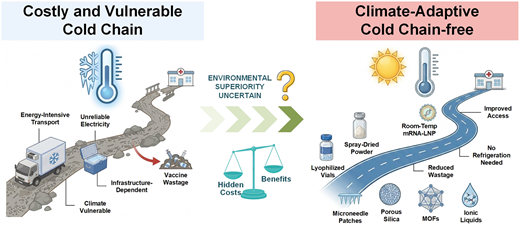
Biologic therapeutics now dominate the pharmaceutical pipeline, bringing an increasing dependence on temperature-controlled supply chains that are costly, energy-intensive and vulnerable to climate disruption, particularly in low- and middle-income countries. Numerous technologies have been proposed to reduce or eliminate this dependence, yet whether they deliver genuine sustainability benefits remains unclear. This review examines that question from a systems perspective by introducing an operational classification of cold-chain dependence, synthesising evidence from life cycle assessment studies, and proposing the Cold Chain-Free Sustainability Index (CCFSI) to support holistic sustainability evaluation. Together, these analyses show that eliminating refrigeration does not necessarily reduce overall environmental burdens, which may instead shift to manufacturing, materials, packaging and product losses. Cold chain-free biopharmaceuticals therefore cannot be assumed to be inherently sustainable; their environmental performance depends on the full product life cycle and should be evaluated using integrated systems-based assessment.